



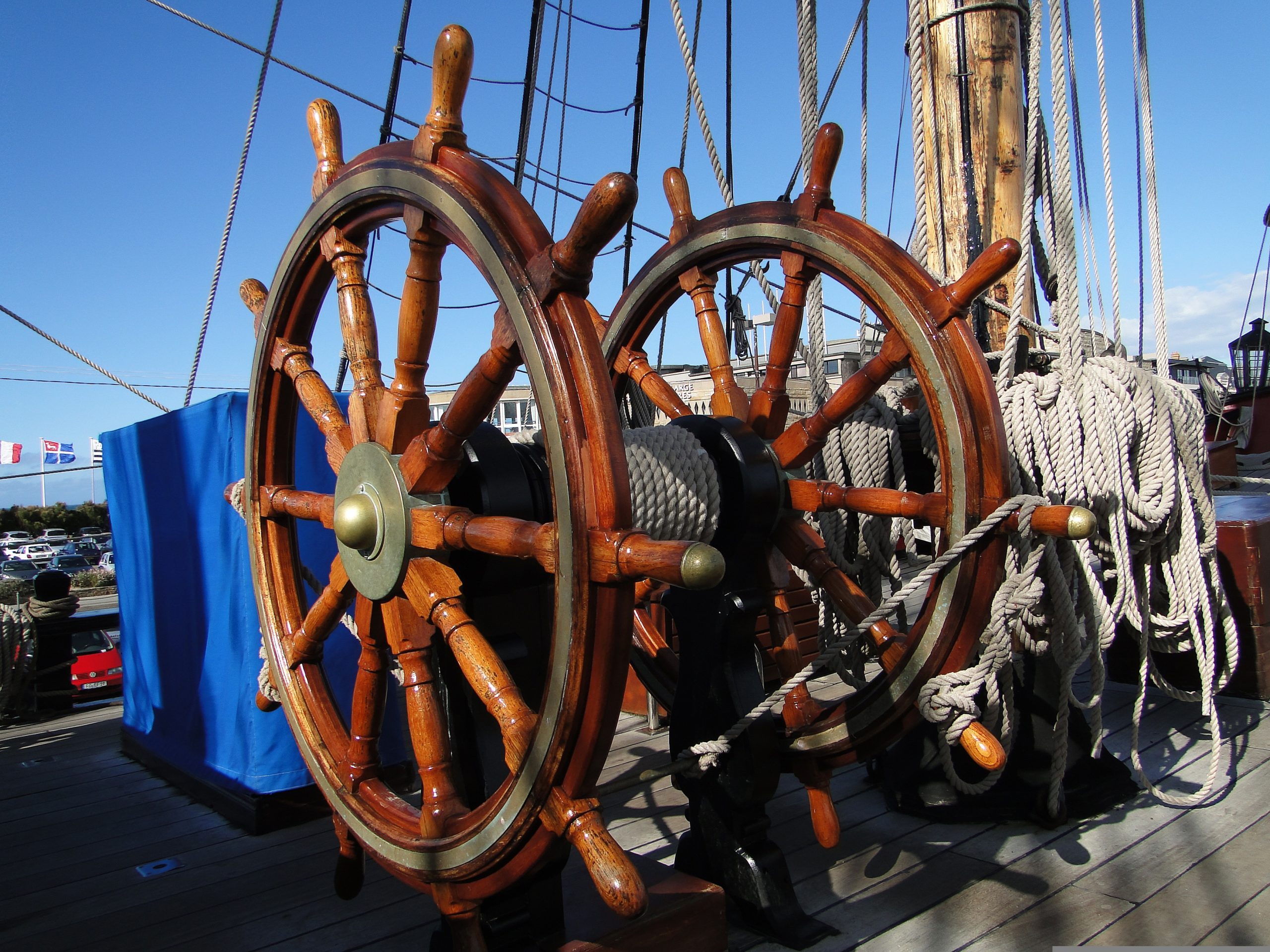
Two Steering Wheels on the Same Ship
Alternative Title: Perception, Control, & the Two Halves
Unlike the human brain, which has been trained to believe that effort leads to progress, the body whole-heartedly leans toward efficiency. Consider the simple act of standing on one leg. What you imagine is based on your experience of that being an easy or hard task. Which leg you chose to stand on also is based on personal history (as is what is the shape or angle of the lifted leg.). We will naturally go with the one we most trust, which is the one we’ve spent more time leaning on.
Now imagine that you have to stand in line for an hour. There are no chairs or walls or counters to support you. Will you stand in perfect symmetry, with each leg supporting exactly 50% of your weight the entire time? No. That would be awful and extremely taxing, both mentally and physically. What you’ll actually do is shift from side to side, handing most of your weight to one hip until it gets fatigued, and then transfer it to the other.
Each leg loads according to its own organizational pattern.
The joints stack differently, as they are relative to which half of bears most load most of the time. To accept more, joints will shift. This will follow how they act once in motion. Your stable side that holds you up will be utilized like brakes. The mobile half, relieved from load bearing duty, will be utilized like the gas or accelerator. Two pedals operating one vehicle.
Taking things further and deeper, we can develop this metaphor into “two steering wheels on the same ship.” Though the body has been simultaneously governing these two wheels since you were born, AND automatically taking into account the dynamic environment and current of the sea, we will strip the already-being-achieved task down to some basic elements in order to conceptualize (and appreciate) it’s magnificent complexity.
A person who’s never been on a boat is asked to guide it from point A to point B. To do this, they have to learn how to maneuver the craft with one wheel, then the other, and finally, the two together. With each, they are expanding awareness and refining how they feel, both independently and in relation with one another.
Which wheel will they choose to try and understand first? The one which the boat is most sensitive to, or the one in which the least turning creates the largest reaction. This would be the half that holds more of your weight or the one in which your center has shifted toward. Because it is weight-accepting, it does not have to learn to push down. Gravity fools us into believing that being pulled downward is the same as pushing down. The joints on this side of the body tend to be twisted, laterally shifted, or lifted out of interactive alignment. This is the consequence from constantly carrying the majority of the load.
Still, our novice skipper learns how to steer the boat from this wheel, not knowing that it is skewed. When they try to direct things using the second wheel, it seems flawed. So different than the first! (And I could complete the ask!). The conflict is the predictive-brain wants to abide by the same rules and mechanisms that it identified as successful. Because the other half is weight-avoidant, it does have to learn to push down. The bones and joints are better aligned, but certain ligaments, tendons, and tissues on this side of the body tend to be deformed, (like a curved Achilles) because they are accounting for the consistent pull towards (or against) the other half.
Each wheel has a role, then, that is designed to function as a pair. It is the nuance between the two where ease is found, with as minimal work as possible for the navigator trying to control the ship. Remember, the boat can stay afloat and sail itself — it just won’t necessarily go where you want it to. Which leads us to the ultimate question: where do you want to go and how much effort are you spending with the resources you’ve got?
[Feature Image by Phil59 from Pixabay.]